Cyrano de Bergerac
a token of love
Navigate to specific articles by using the menu icon in the upper, right-hand corner of this page.

Cyrano de Bergerac
(AI art inspired by photographs of the production.)
A WIFE'S REQUEST 
My mother was always shy and introverted. She let Dwain have the spotlight, endured his humor and was his greatest advocate. But she did ask one (and only one) thing of him during his career. She asked him to direct Cyrano de Bergerac. It was her favorite love story and, as a love token to her, he gave her what became the finest production of his career. He even called her in to coach Don Harreld's Cyrano to sound more like John Uhlenhopp's Christian during the balcony scene but we'll get to that in a minute.
Mr. J did not undertake Rostand's immortal classic lightly. It's an unabashedly romantic story but the line between its sincere sentimentality and parody is thin. This was evidenced most clearly in the TV comedy Welcome Back, Kotter, (airing in 1977, the same year as Mr. J's production.) The episode "Has Anyone Seen Arnold?" showcases the goofball talents of Ron Palillo and John Travolta but, in doing so, trotted out every tired cliché about how pathetically bad high school theater is.
While Mr. J wasn't shooting for the unrealistically polished performances featured decades later in Glee, he did aim to show the audiences of Rochester, MN how good young theater students could be. And he knew he could never do that without a Cyrano and a Roxanne. (Anyone who has ever sat through a production of My Fair Lady or Hamlet with a disappointing title character knows what I mean.)
But unlike other educational theater programs, Mr. J staunchly refused to pre-cast. (Pre-casting ia a somewhat clandestine practice in which a director approaches select actors to hint or to tell them outrightly that he/she plans to cast them in a certain role.) Dwain considered that to be an assault on everything he held dear and so he had to bide his time until the actors whom he felt could handle the leads appeared. Then he scheduled the show, gambling that those actors would even audition and prove to be as good as he thought they could be.
His caution paid off with Don Harreld and Sue Sheps. Harreld had worked with Johnson the year before as the hilariously imperious Captain Miles Gloriosus in Sondheim's A Funny Thing Happened on the Way to the Forum. Sheps appeared in the smaller but equally comical The Man in the Bowler Hat, by A.A. Milne. (Yes, the A.A. Milne.) They were joined by the very able John Uhlenhopp who played the hapless Christian and the bedrock of the play was complete.
Rochester, MN in the 1970s was populated, in part, by Mayo Clinic doctor's and IBM executives. Mr. J was quietly proud of the fact that many of Mayo's season ticket subscribers— yes, they sold season tickets to high school theater— were people who did not have children in school and who had the means and opportunity to see professional theater in New York, London and Los Angelas. These were the same people who communicated to Dwain that they enjoyed his plays equally to the Equity professionals they saw elsewhere. Cyrano, in particular, was a smash hit.
What Became of the The Leads
Senior Don Harreld would cap off his high school career the following spring by returning to his comedy roots in Neil Simon's The Good Doctor. Juniors John Uhlenhopp and Sue Sheps would reteam in the musical Anything Goes, featuring Uhlenhopp as the lead and Sheps in a surprisingly small role. But they had even bigger fish to fry in their future...
Don Harreld
Don Harreld served as the Senior Vice President for Education and Executive Director at Easterseals. For more than 20 years, he worked in higher education and leadership, including a decade in university administration—most recently at Brigham Young University. Alongside his academic career, Don had spent many years in nonprofit and corporate roles, helping organizations strengthen their approach to disability advocacy, training, and leadership development. He earned his Ph.D. from the University of Minnesota and held an executive management certificate from the University of Southern California.
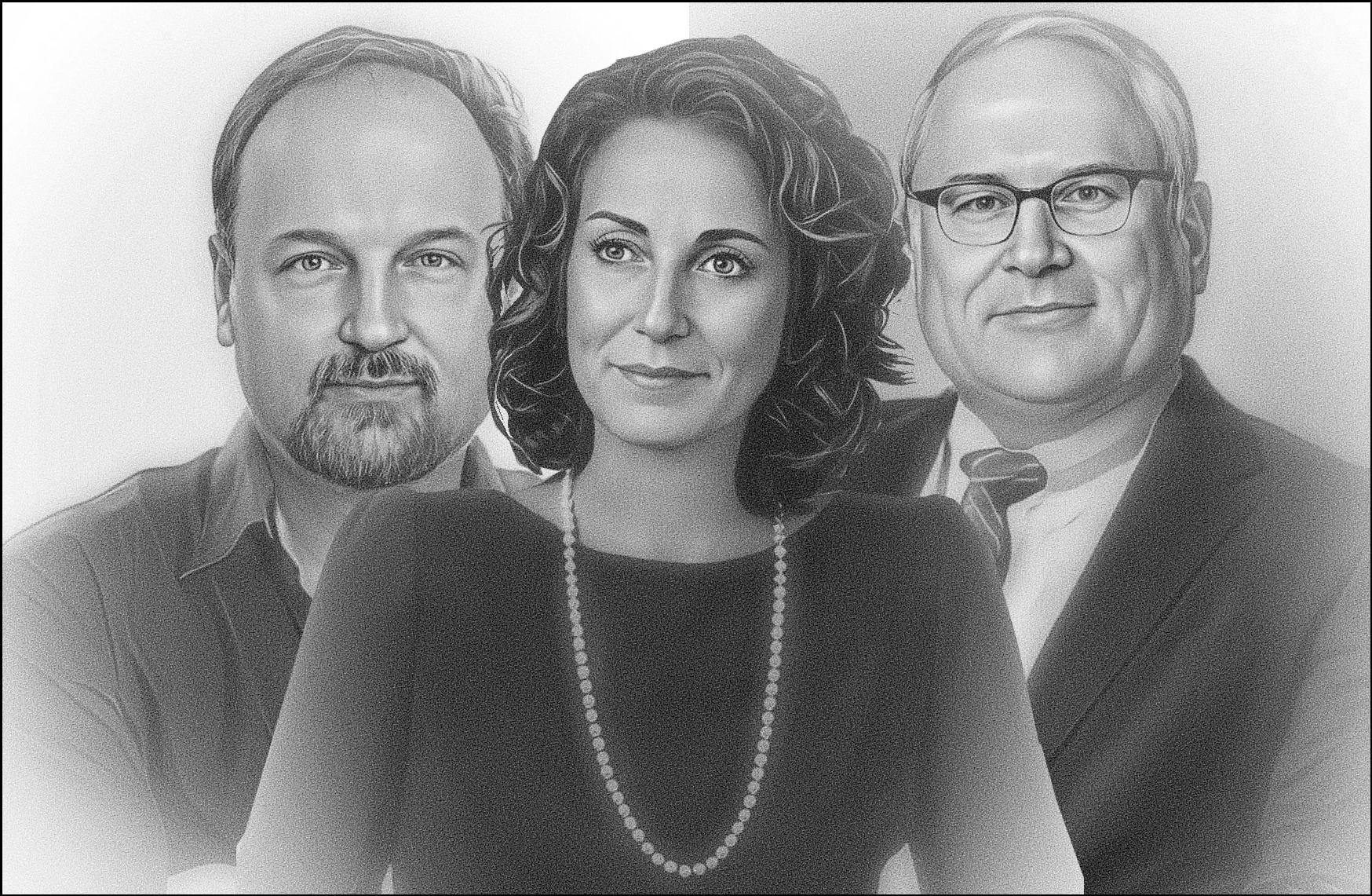
Susan Margulies
Susan Margulies is an American engineer and assistant director at the U.S. National Science Foundation, where she led the Directorate for Engineering. She also held the title of Georgia Research Alliance Eminent Scholar in Injury Biomechanics and was a professor in the Wallace H. Coulter Department of Biomedical Engineering at the Georgia Institute of Technology and Emory University, where she also served as chair. Widely recognized as a world leader in the biomechanics of infant head injury, her research advanced the understanding of traumatic brain injuries in children. Margulies completed her undergraduate education at Princeton University in mechanical and aerospace engineering, followed by her Master’s and PhD in biomechanical engineering at the University of Pennsylvania, where her work focused on the biomechanics of traumatic coma.
After earning her doctorate, Margulies worked at the Mayo Clinic as a postdoctoral researcher in a pulmonary lab before joining the University of Pennsylvania, where she became the first woman professor in the Biomedical Engineering Department. She led the Injury Biomechanics Lab, advancing research in lung and head injuries through animal models, computational models, and clinical studies. She launched the Neurointensive Care and Assessment Facility with NIH support, combining molecular biology with injury models to pursue new therapies for trauma. Beyond research, she served as chair at Georgia Tech and Emory, joined the advisory board of Astrocyte Pharmaceuticals, and attracted substantial funding while publishing extensively. Her pioneering work led to her election to both the National Academy of Engineering and the National Academy of Medicine for her groundbreaking contributions to understanding and treating brain and lung injuries.
John Uhlenhopp
John Uhlenhopp, a Minnesota-born tenor who grew up in Bogota, Colombia, emerged as an internationally recognized talent after winning the 1994 Richard Tauber International Tenor Competition and several other prestigious awards, including the Metropolitan Opera National Council Auditions and the Liederkranz Foundation Award. He quickly established himself as a versatile and in-demand tenor, making his European debut in 1995 and later joining the ensemble at Luzerner Theater, where he performed leading roles in works by Gounod, Mozart, Verdi, and Berlioz. His British debut as Pinkerton in Madama Butterfly at the Royal Albert Hall marked another career highlight and opened the way for further major guest appearances across Europe, including at the Vienna Volksoper, Den Norske Opera in Oslo, and in London as Cavaradossi in Tosca.
His career has spanned significant performances in both Europe and the United States, where he has appeared with renowned companies such as the San Francisco Opera, Seattle Opera, and the Cincinnati Opera, in roles including Don José in Carmen, Alfredo in La Traviata, and Arturo in Lucia di Lammermoor. Uhlenhopp’s repertoire covers demanding and complex works, from Wagner’s Tristan und Isolde and Strauss’s Wozzeck to Britten’s Peter Grimes and Shostakovich’s Lady Macbeth of Mtsensk. Beyond the opera stage, he has built a strong reputation in concert performance, appearing with orchestras such as the Prague Philharmonic and the Rheinische Philharmonie, in works ranging from Dvorák and Mahler to contemporary composers. This balance of operatic and concert achievements, along with his embrace of contemporary music, established him as a highly versatile and acclaimed tenor on the international stage. [AI summarized bio, taken from johnuhlenhopp.com]
CYRANO'S STAGE MANAGER: THE SHOW MUST GO ON
The following is a ROCHESTER POST BULLETIN feature by Pauline Walle
When Jay Toogood was lying in the hospital with one hand amputated and the nerves destroyed in his other wrist last summer he got a call from his high school drama coach letting him know he still had his job as stage manager this year. "We're interested in your brain, not just your hands," said Dwain Johnson at Mayo.

[POST BULLETIN photograph]
Thus Jay is busy on the set of Cyrano [de Bergerac] this week, directing the efforts of 60 tech workers backstage. And after the 7 p m. stage call on opening night Thursday, he'll be boss of the show.
Jay, a senior, was the victim of a fire-related accident in the Boundary Waters Canoe Area last summer. Watching for flames on top of a cabin, the youth counselor fell off the roof and automatically grabbed, catching 14,400 volts.
The mishap put him through nearly 20 trips to surgery, at least 10 of them major. He has a prosthesis on his left arm. Doctors are attempting to save the use of the other with transplants.
Amazingly, Jay is able to drive a car and virtually take care of himself including such chores as brushing his teeth.
"It takes a little longer, but I get it done," he smiles.
Displaying the independence of any youth his age, the son of Mr. and Mrs. Gary Toogood has gone on about the business of classes, plays, con-certs and parties with his girlfriend. He is being tutored in one subject for which he missed some work. He has even fitted in a vacation break to Barbados with friends.
An active member of Bethel Lutheran's youth group. Jay has Considered the ministry, and law, and will be going to Rochester Community College for at least a year while he thinks about his career.
But right now he's concentrating on a play which has to take shape by curtain time Thursday. His assistant climbed a ladder in the wings Tuesday night and other students hammered away at parts of the set. Jay walked around with a clipboard and helped create some props. He can pick up a piece of paper off the floor with his prosthesis and came over with a roll of paper toweling when the reporter got into some paint.
He typifies the type of dedication that Johnson sees returning to speech and drama. "We had the demonstration period, and then the time when theater was a social event and some kids wouldn't come out if it couldn't all be fun." he said "These kids really work at it. It's serious business again."
Johnson has always wanted to do "Cyrano" because "romanticism shows us the way things can be, when realism tells us that's the way it is." Jay Toogood's attitude quietly parallels that theory. Right now the play's the thing and the show must go on.
With his whole life.
MRS. J, CONSULTANT
As Claire Van Zant remembers, each opening night of my father's career at Mayo my mother, Noreen appeared at his side. She always looked stunning with an attractive evening dress and (according to Lady Claire,) a corsage. These were still the days that even a high school's opening night prompted telegrams and semi-formal dress. I don't remember the corsage but I remember "Mrs. J" being her husband's strength and stay throughout the 60 years they were together.
They met in the mid-50's when both taught in the English department of Staples High School. She was even his tech director for the unfortunately titled comedy Time Out For Ginger in 1958. By the mid-1970s, Noreen had retiring from teaching but returned to work as a medical editor for the American Academy of Ophthalmology and Otolaryngology.
Dwain decided to tap Noreen's keen ear and appreciation of vocal tone by asking her to coach Harreld and Uhlenhopp in the scene in which Cyrano vocally mimics Christian in the shadows below Roxanne's balcony. In typical Noreen form, she was self-effacing and claimed that she "didn't do much" but the scene was heartbreakingly effective and she enjoyed working with the young men.
DON HARRELD DROPS HIS TECHNIQUE : THE BREAKTHROUGH OF AN ACTOR

POST BULLETIN photograph
The following also appears on the STORIES page.
I don't know when Mr. J perfected his legendary vocal volume. The skill was ironic given that he had a debilitating stutter as a child and spent years not talking much at all. He famously taught himself not to stammer by standing in front of a mirror and then, years later, developed the ability to project his voice so loudly it shook entire auditoriums.
He used it as a teaching tool, most often when directing plays. Standing at the back of the auditorium, he would bellow "LOUDER!!" to a soft-spoken thespian or some other admonishment to a teenaged miscreant. Those yells had the effect of cannon fire. They were galvanizing, even for the students who spoke of them in fear. That volume, more than any other aspect of his personality, seems to be the thing people remember first and foremost.
In today's culture, it's important to understand that, yes--there was an element of calculated intimidation to his judicious bellows. However, the aim was not to bully. The aim was modeling confidence, urgency and command. He didn't do it nearly as often as legend claims. Dad was a big believer in not diluting effectiveness by overdoing things. He used it when it would produce the results he needed and no more.
And he wasn't above using it for comedic effect! In 1977, during a rehearsal for Cyrano de Bergerac (arguably the triumph of Dwain's career,) the leading man Don Harreld had been struggling to drop his "technique" and to embody the soul of one of the most romantic figures in literature. I was there the night that, after a grueling battle, Don finally triumphed and "Cyrano" broke through.
"DON HARRELD!!!" came a thunderous explosion from the darkness at the back of the house.
All movement stopped. Everyone tensed. Don turned in genuine terror and I remember that he cowered.
"I'M PROUD OF YOU!!!" came the second shout.
Don's knees literally went weak and he slumped against a castmate. The auditorium burst into laughter for Mr. J and applause for Don.
And then Mr. J moved the rehearsal along.
THE NIGHT PART OF THE SET COLLAPSED
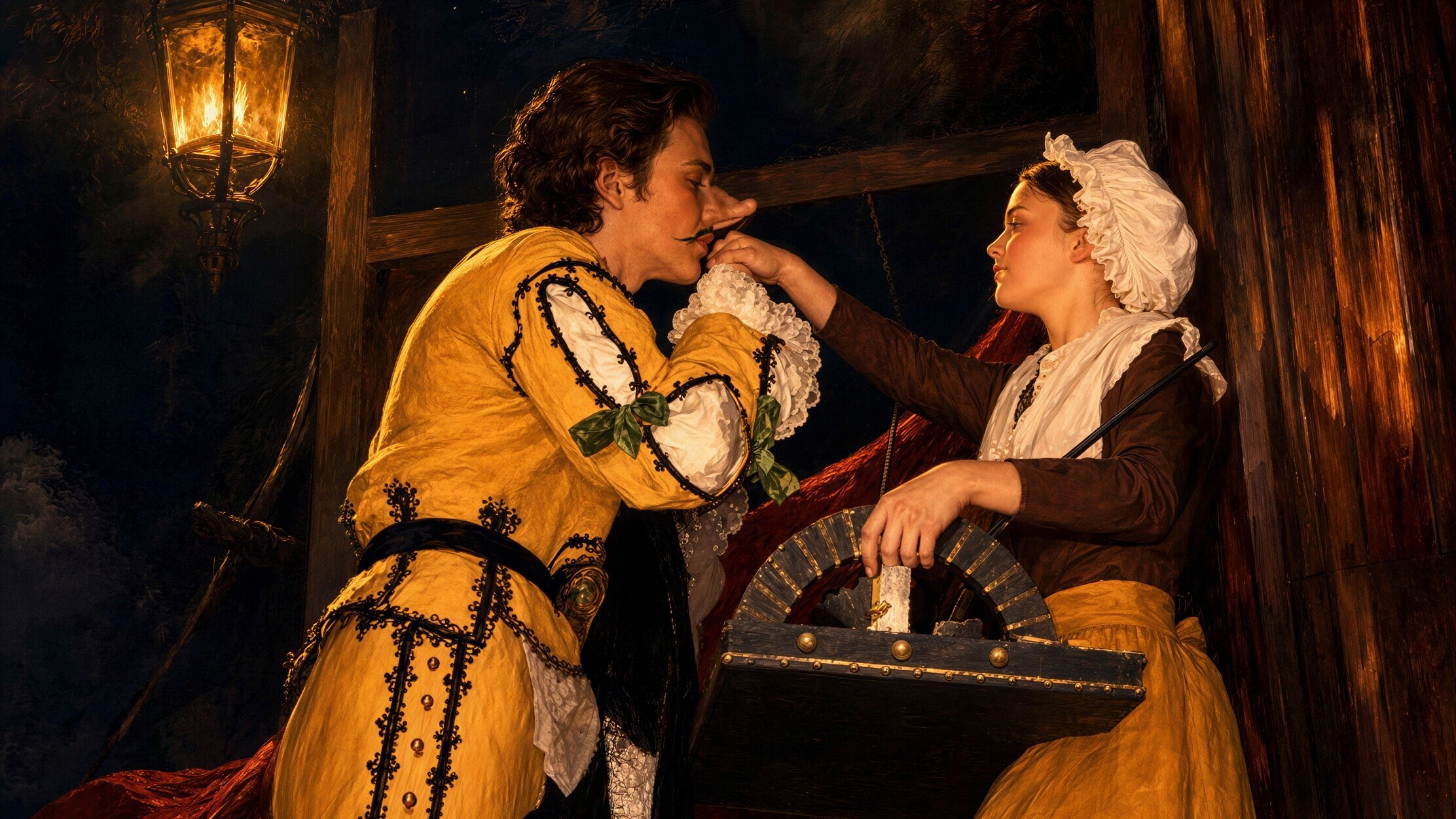
(AI art based on photograph by ROBIN JOHNSON)
I doubt many people remember the moment during a performance when part of the set collapsed. The fact that I struggle to remember the precise details of the occurrence is a testament to how good the show was. People remember everything before and after that moment-- when a group of high school students and their director pulled off a production that rivalled the pros. And any theater person, professional or amateur, will tell you that disasters happen all the time. But at that moment, I saw my father crushed.
It was the final scene; the worst scene for a disaster like this to happen. After an hour and a half of romance, drama, comedy, sword fights and intrigue Cyrano arrives at the convent, mortally wounded but determined to deliver his last "gazette" to the widow Roxanne. In the course of the scene, he lets it slip that it is actually he that Roxanne has loved through the years. There was barely a dry eye in the house.
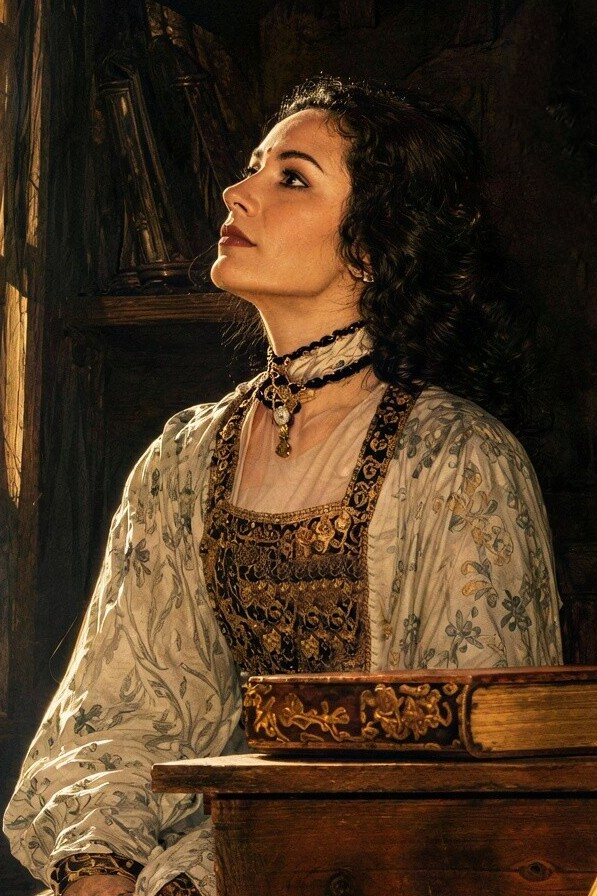
(AI art based on photograph by ROBIN JOHNSON)
It was the second of three performances of the show. There was something wrong with the bench on which someone was sitting that forced the actor to sit on the very edge to avoid sending it toppling. If that wasn't bad enough, a heavy branch (the scene was set outside) or a beam or something was not secured and the heavy object came crashing down, narrowly missing the actors. (Almost subjecting Don Herrold to the same fate as his character.)
It was a huge crash. It wasn't something the audience would miss. By design, Dwain had schooled his actors to achieve utter discipline. They continued the scene as if nothing had happened and the audience was rewarded with professional-level composure.
The audience rose in a standing ovation but as they filed out, my father remained in his seat, staring down at the floor. A few minutes later, he would rise and walk out to the lobby to greet well-wishers as normal. Then he headed backstage to confront the crew. I remember only the gist of what he said to them. It was delivered in a calm, controlled manner but it left no room for misinterpretation. They would fix the fallen portion of the set and, as for the bench, he would arrive at the theater early the next night where he would personally jump up and down on it to ensure its stability.
Mr. J's reputation for professionalism meant that he didn't really need to say anything to them. The pale-faced, shaky recipients of his orders were all so personally hurt by the failure they would have moved heaven and earth to make it right. It wasn't even that they felt they'd failed him. They felt they had failed the project, the team. But it wasn't the damaging shame that 21st Century psychology is so worried about. It was a galvanizing shame— felt for others— and motivating an empowered determination to make things better.
The final show went off without a flaw. The show, in many ways, defined my dad's career. But in private, I know he played that moment over and over in is head.
I'd do the same.
MR. J'S SHADOW
I know my father's Cyrano de Bergerac backwards and forwards. Despite being 12 years old at the time, I think it's safe to say I knew it even better than my sister, Lisa, who was in the cast (playing Ragueneau's haranguing wife, Lise.) By the time the show began, I had already acted in a Dwain Johnson production and had a short history of accompanying him to rehearsals. In the early days, those visits were little more than opportunities to play amongst the empty rows of seats and run (quietly) up and down the carpeted inclines.
But by 1977, I had a vague inkling that I wanted to do what he did when I grew up. So I attended every rehearsal— I became his shadow— not to actively study his process but to absorb it, night after night. I think that nightly exposure to Edmund Rostand's classic story either inspired the romanticism that lives in me or at least accelerated it. I know that the nightly exposure to my father at the height of his career would inform everything I would become as an adult— from self-producing a theatrical premiere to acting onstage at the Guthrie Theater in Minneapolis myself— I owe, in part, to Cyrano.
I listened. I learned.
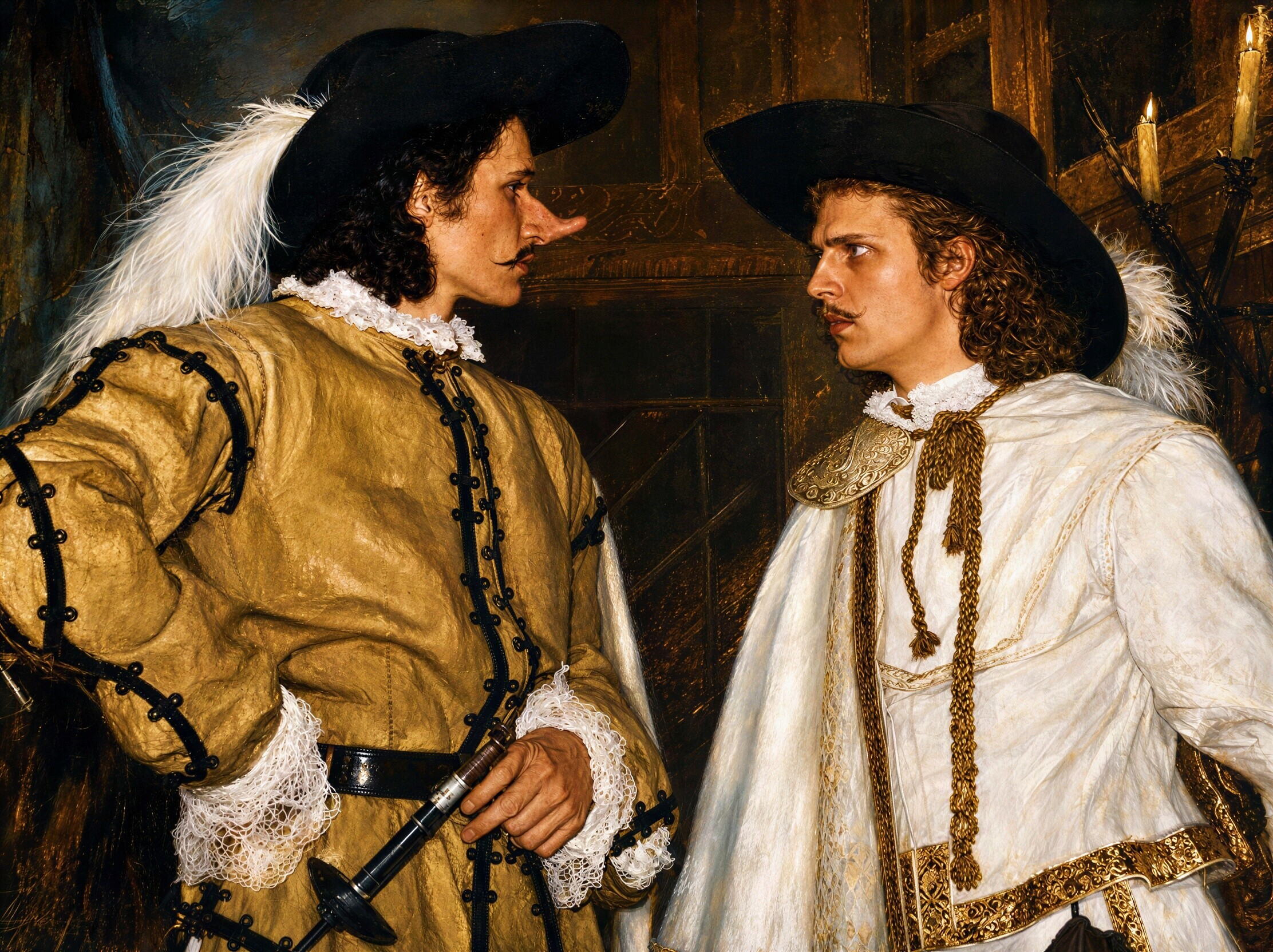
(AI art based on the original yearbook photo)
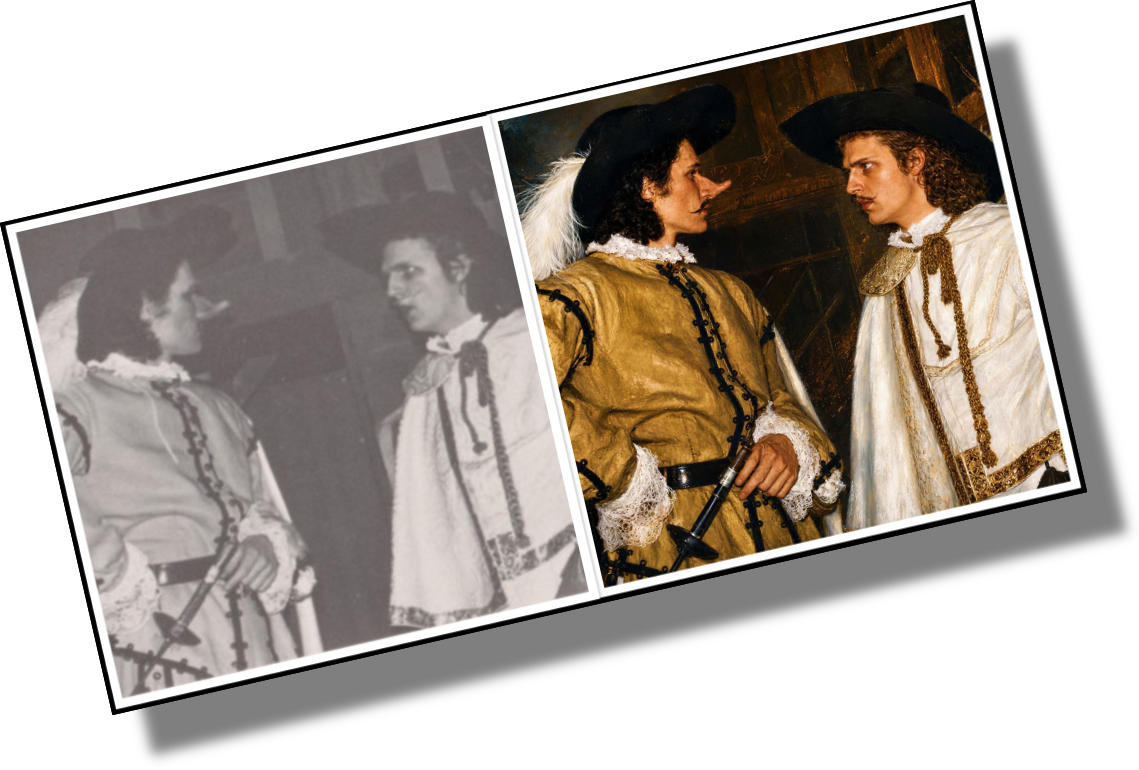
NOTE ABOUT MY CHOICE TO USE AI
In the 1970s amateur photographers were not as good as they are today. The constant exposure to good pictures that social media can afford us, plus the pressure younger people in particular feel to "curate" every moment of their life has resulted in a lot of things but one of them is quality images that far surpass the era of "just-get-everything-in-the-frame."
And while AI itself comes with implications I find genuinely frightening, on the benign end of the spectrum lies the ability to restore old photographs that fade to invisibility and to add creative components I wouldn't have dreamed possible a year or two ago.
Cyrano is a case in point. On this page, you'll see a collection of images originally taken by me, (at age 12) on a KODAK Tele-Instamatic, yearbook photos and photos taken by the Rochester Post Bulletin newspaper staff. All photos except mine are in black-and-white. All of them are low resolution and some are filled with halftone dots. And with the arguable exception two of them, none capture the romance, the emotion or the grandeur of the real production.
And so I turned to AI. At first, I merely restored, colorized and clarified the originals. They look exactly like they would have looked if we had great equipment to use originally. But then I asked it to take a step further and to create romantic interpretations of the original images, always insisting that the people and the costumes remain intact and true-to-the-original. For better or worse, new technology has added the depth-of-feeling that aging images can not. My apologies to the Rochester Post Bulletin photographer and the photographer of The Odyssey yearbook whose names have been lost in the mists of time.